Plate-reading cameras used to sit only at intersections, with a pole and a sign nobody missed. Now they show up bolted to a stop sign or tucked into a plain box on a fence, and you’d walk right past one without a second look. We spent August teaching Minino to notice them anyway.
What is the Flock/ALPR detector?
It’s a new detection engine inside Minino’s firmware that flags surveillance gear by its wireless fingerprint — automated license-plate readers (ALPR) like the Flock brand, body cams, and card skimmers. We built it for anyone doing a physical-security walk-through who wants to know what’s already watching the block, the same instinct that got us pointing Minino’s GPS at things in the first place.
Do you need to open the camera to know it’s there? No — Minino listens for what it broadcasts instead.
What’s new?
- A Surveillance/Flock-ALPR engine that checks WiFi and Bluetooth traffic against the maker fingerprints and network names those cameras, body cams, and skimmers use.
- A scoring engine with decay and cooldown, so one stray signal doesn’t set off a false alarm — the score climbs only when the same device keeps showing up.
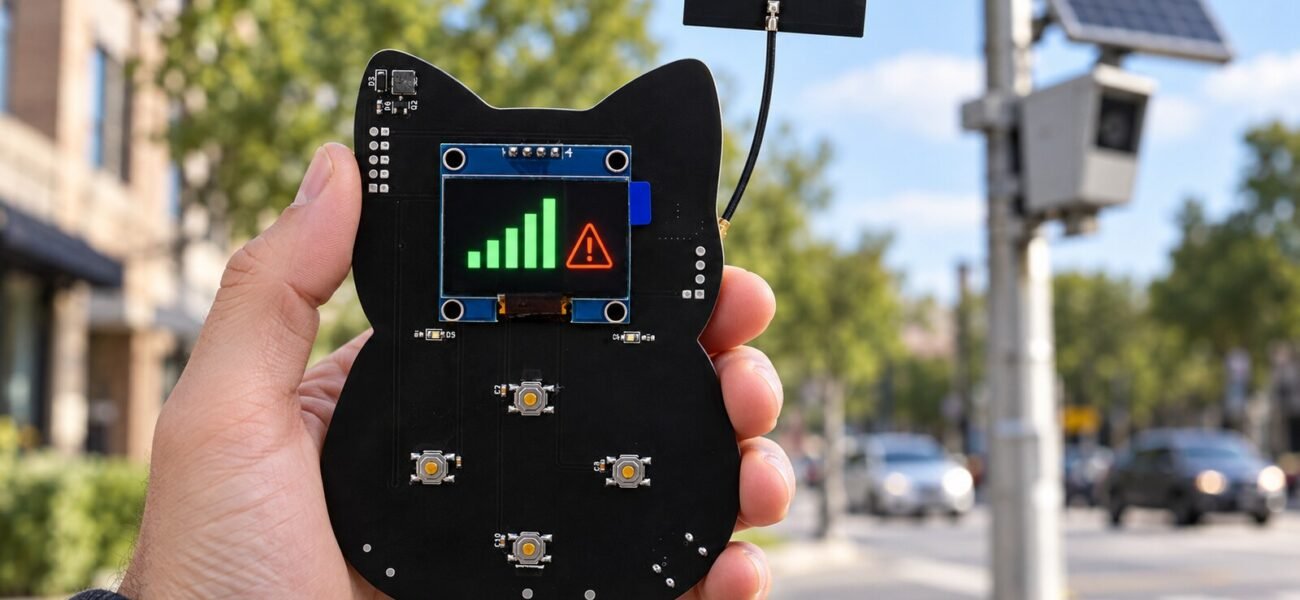
- A redesigned tracker screen with a live signal-strength meter and your GPS coordinates, so you can walk toward a match instead of guessing which direction it’s coming from.
- Bundled in firmware v1.1.15.0, released September 1, 2026 — anyone with a Minino can flash it today.
Why build a scoring engine at all instead of a simple yes/no alert? Because a single stray packet from a passing car isn’t the same as a camera sitting on the same corner for an hour, and we wanted Minino to tell the difference.
This isn’t the first time we’ve pointed Minino’s GPS at something worth mapping. Our wardriving demo is still our most-watched Minino video, with over 2,500 views, and it walked the same basic idea for open WiFi networks: log what’s broadcasting, tag it with a location, and let the map do the explaining. We reused that same GPS-plus-signal-strength combination here because it already worked.
What can I do with it?
Walk a street or a parking lot before an authorized physical-security audit, and see what surveillance infrastructure is already installed — with the client’s permission, the same way you’d only scan networks you’re allowed to test. That’s the exact audit we had in mind while building the scoring engine.
You can also carry it on a normal walk, just to see what’s transmitting near your own home or office — no audit required, only curiosity about your own street.
Is a match proof there’s a camera bolted to that pole? Not quite. It means the fingerprint looks right, and the scoring engine is there so you trust a repeated hit more than a single one. New gear that isn’t in the fingerprint list yet can still slip past — if you spot something we’re missing, tell us and we’ll add it. That list only gets better the more people are out there carrying one of these in their pocket.
Where do I get it?
Grab the update from the Minino releases page if you already own one, or start with the Minino ficha if you don’t. The engine and its use cases are documented in the Minino README.
We covered the short version of this inside our ESP32 Marauder guide too, but it earned its own post once we saw how much people wanted to know about it.
Happy hacking — and remember, only scan what you’re allowed to.