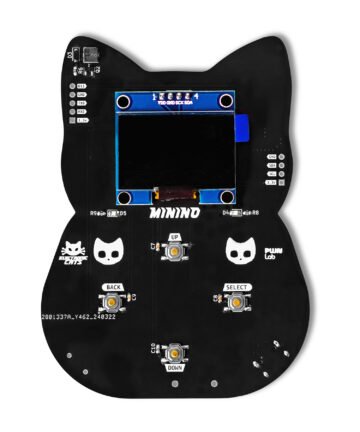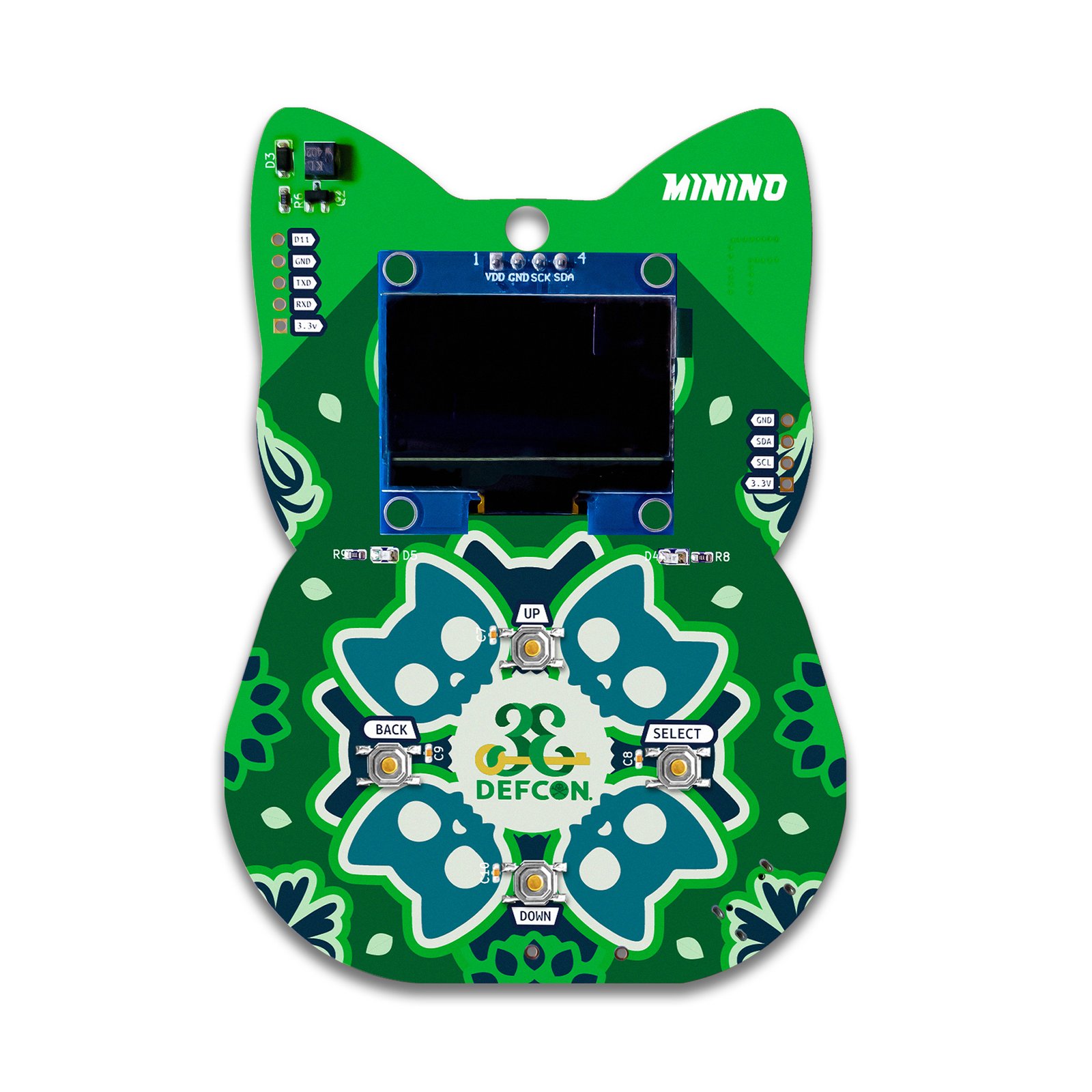
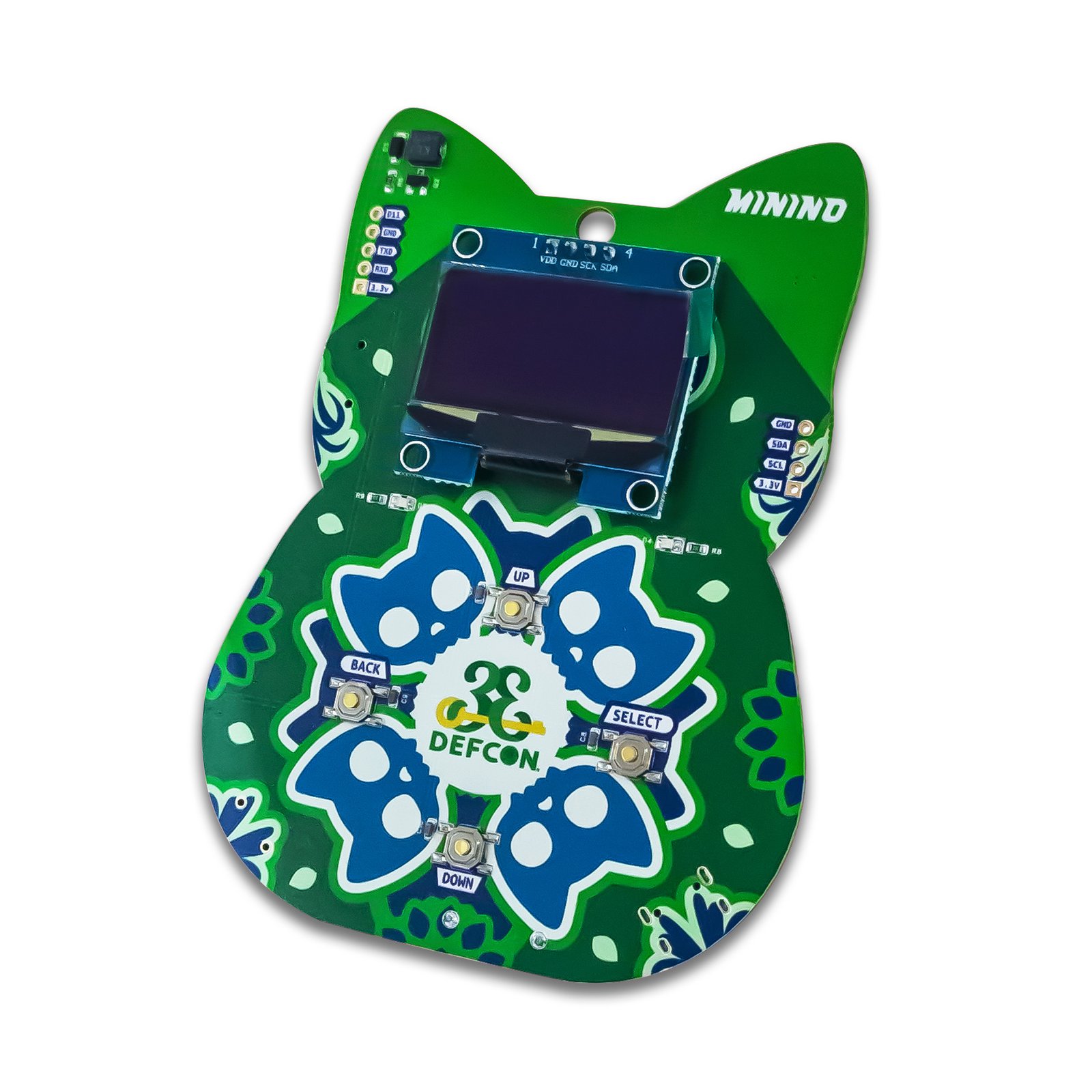
Minino – DEFCON 33
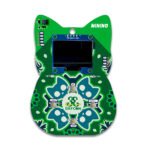
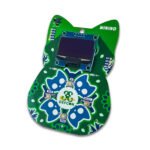
The DEF CON 33 special edition of Minino: the same multiprotocol WiFi/BLE/Zigbee/Thread security testing board, with onboard GPS, in a never-restocked collectible run.
$70.00
Out of stock
Email when stock available
- Wireshark
- PyCatSniffer / CatSniffer-Tools
- Wigle.net
- Wi-Fi Spectrum Suite
In the box
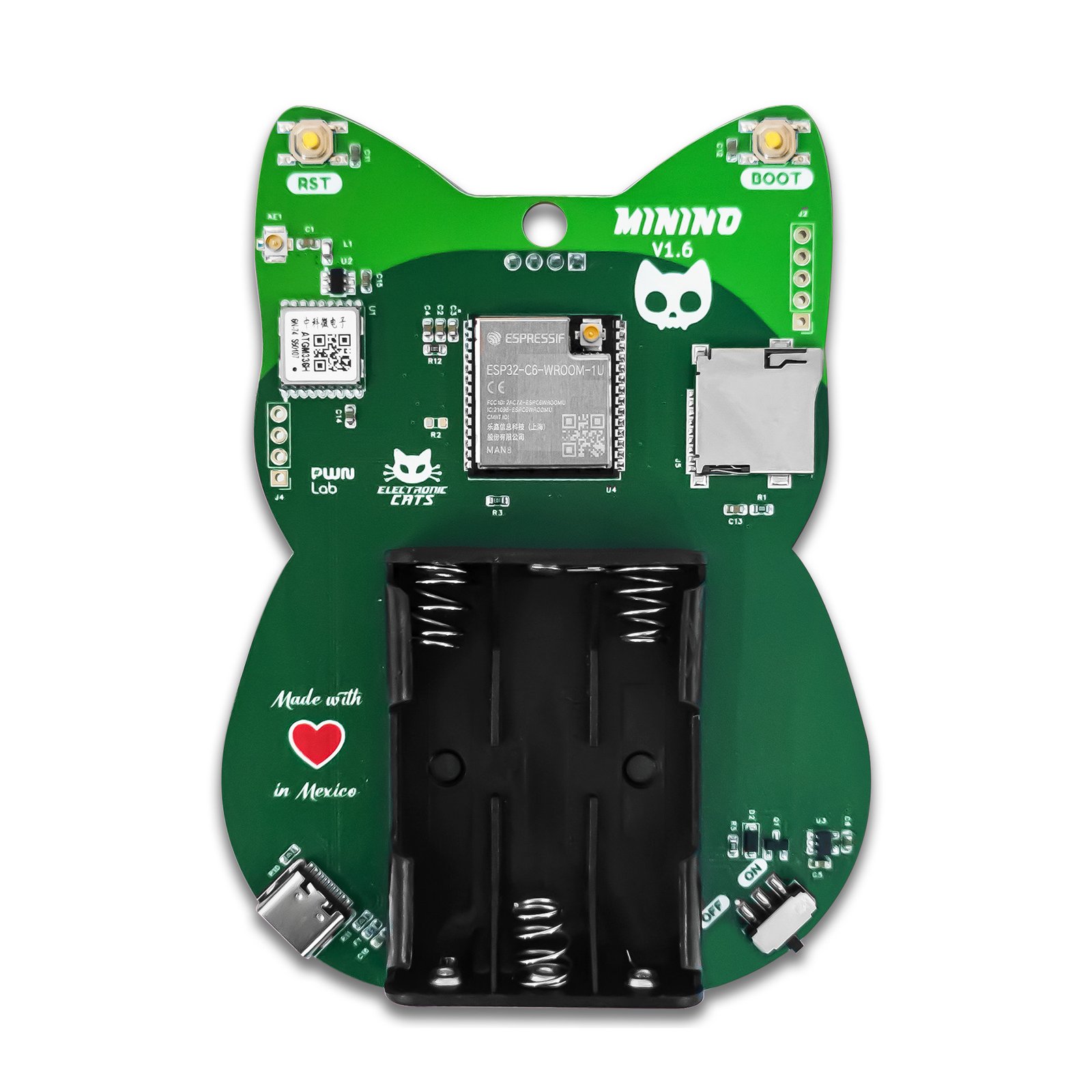
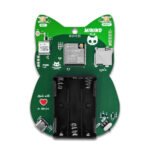
3x AAA battery holder
Not included
AAA batteries and a microSD card.
You also need
3x AAA batteries (the holder ships with the board, the cells do not) and a microSD card, up to 2 TB, for the apps that log data: wardriving, .pcap captures and the file manager.
- 174 GitHub Stars
- Released at DEF CON 33
- Designed and built in Aguascalientes, Mexico
- Hardware CERN-OHL v1.2 · firmware GPL-3.0
Map Open and Insecure WiFi Networks While Wardriving
You want a repeatable way to spot open or insecure WiFi networks across an area. Enable GPS and run Wardriving from the Applications menu, then upload the resulting files from the microSD to Wigle.net. You get back a downloadable KML map, importable into Google Earth, showing coverage gaps, public hotspots, and insecure networks.
Detect DroneID and Remote ID Signals From Nearby Drones
You want to know what a drone overhead is actually broadcasting. Enable GPS and set your WiFi region, then open Applications > WiFi > DroneID Scan. Minino shows each detected drone’s channel, authentication type, and real-time GPS coordinates.
Understand Your First Packet Capture
New to network captures? After a WiFi analyzer session, run the free community script Easy Minino on the resulting .pcap file — on your own or in a workshop setting — and get back a plain, readable table of packet type, SSID, source/destination MAC, and channel, with no manual parsing required.
Start in 10 minutes
- Power on Minino using 3x AAA batteries or a USB cable and flip the switch to ON; press the RST button if the display stays blank.
- Navigate the on-device menu with the SELECT (right) and BACK (left) buttons, or open a serial console at 115200 baud (PuTTY on Windows, Minicom on macOS/Linux) for full command-line access — see the Minino wiki for the complete menu and console reference.
- In Settings > System, set the WiFi Region to match local regulations before running WiFi apps, and set the time zone and enable GPS before running location-based apps (wardriving, DroneID).
- Insert and, if needed, format a microSD card via Settings > System > SD Card before running apps that log data.
- Launch an app from the Applications menu (WiFi, Bluetooth, Zigbee, Thread, GPS, GPIO, or File Manager) — check the latest firmware release (v1.1.15.0) for new apps and fixes before you start.
| Dimensions | 18 × 12 × 4 cm |
|---|---|
| MCU | ESP32-C6 (ESP32-C6-WROOM-1 module), up to 160 MHz |
| Flash | 8 MB |
| Radio | WiFi 6 (802.11ax) 2.4 GHz, backward compatible with 802.11b/g/n (2.4 GHz only), Bluetooth Low Energy (BLE), IEEE 802.15.4 (Zigbee, Thread) |
| GPS module | ATGM336H(-6N-74) Zhongkewei GNSS |
| Display | OLED screen with physical navigation buttons |
| Storage | microSD card slot, up to 2 TB |
| Connectivity | USB-C (power/data) |
| Exposed I/O | 1 digital I/O pin (D11), I2C and UART pins |
| Dimensions | 82.5 x 110 mm |
| Power | 3.3V I/O, 3x AAA batteries (holder included, not rechargeable) or USB |
| Firmware license | GNU AGPL v3.0 |
| Hardware license | CERN Open Hardware Licence v1.2 |
| Feature | Minino | Flipper Add-On: Marauder |
|---|---|---|
| What it is | Standalone multiprotocol wireless security testing board with its own OLED screen and buttons; no other device needed | Add-on board for the Flipper Zero; a Flipper Zero is required |
| Microcontroller | ESP32-C6, up to 160 MHz | ESP32-S3, up to 240 MHz |
| WiFi | 2.4 GHz WiFi 6 (802.11ax), backward compatible with 802.11b/g/n; no 5 GHz | 2.4 GHz 802.11b/g/n with 40 MHz bandwidth |
| Bluetooth | Bluetooth Low Energy | BLE 5 with Coded PHY (long range) and 2 Mbps PHY |
| Zigbee / Thread (IEEE 802.15.4) | Yes, integrated radio | Not part of the ESP32-S3 radio set (WiFi and Bluetooth only) |
| GPS | Onboard ATGM336H GNSS module for wardriving and location logging | No GPS listed |
| Storage | microSD slot (cards up to 2 TB) for .pcap captures and wardriving logs | Not listed |
| Firmware | Electronic Cats’ own firmware, preloaded and updated on GitHub | ESP32 Marauder firmware (upstream open-source project), factory-loaded |
| Editions | Minino, plus DEF CON 33 and DEF CON 34 special editions | Marauder, or Marauder + MagSpoof (adds magnetic-stripe emulation) |
Minino is not turning ON -- what do I do?
Power Minino using 3x AAA batteries or a USB cable, then flip the switch to ON. If the screen stays blank, press the RST button.
My Minino isn't picking up the GPS signal -- why?
Check Settings > System > GPS: make sure GPS is enabled and your time zone is set. This menu controls location-based apps like Wardriving and DroneID Scan.
What microSD card can I use with Minino?
Minino supports microSD cards up to 2TB, used to store .pcap captures, wardriving logs (.gpx/.csv), and other app data. Insert the card (formatting it if needed) from Settings > System > SD Card.
Is Minino an alternative to the ESP32 Marauder?
Partly. Minino is not a Marauder board and does not run the Marauder firmware: it is a standalone Electronic Cats board with its own preloaded firmware, screen and buttons, so it needs no Flipper Zero or phone. On 2.4 GHz WiFi and Bluetooth Low Energy it covers much of the same ground for testing networks you are authorized to assess, and it adds what the ESP32 Marauder radio set does not have: Zigbee and Thread (IEEE 802.15.4) sniffing, an onboard GPS for wardriving, and a microSD slot for .pcap captures and logs. If you already own a Flipper Zero and want the Marauder toolset itself, the Flipper Add-On: Marauder is the right pick; the comparison table above shows the differences side by side.